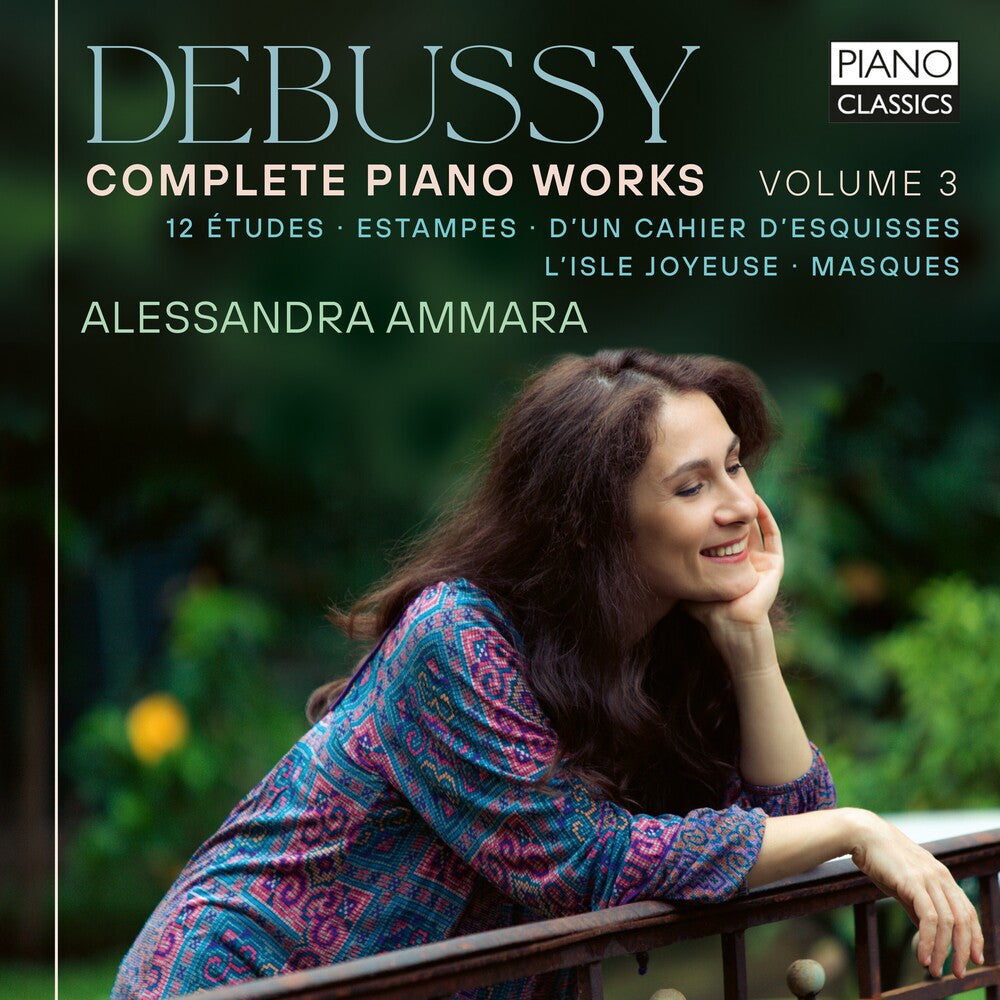

Alessandra Ammara - Debussy: Complete Piano Works Vol. 3 [CD]
Alessandra Ammara - Debussy: Complete Piano Works Vol. 3 [CD]
Release Date: /// Piano Classics
Couldn't load pickup availability
Principally surveying the Preludes and Images, the first two volumes of Alessandra Ammara's Debussy survey have attracted praise for their affinity with the composer's elusive but painterly idiom. According to Fanfare, 'Ammara reveals her sensitivity to the Debussy sound world, rife with blurred outlines of objects and infiltrated with variegated light, in the manner of the painter J.M.W. Turner.'For Volume 3, her focus turns principally to the set of 12 Etudes which miraculously took shape over the course of just two months, in August and September 1915. Plagued by ill-health following the diagnosis of rectal cancer in 1909, presented with the pressing need to increase his earnings through editing and performing, Debussy wrote the Etudes while staying in a town near Dieppe, on the Normandy coast. Emerging from a period of severe depression, he once more took inspiration from the sea in a sudden and final burst of creativity which also saw the composition of the suite for two pianos, en blanc et noir, and the Sonata for Flute, Viola and Harp. However, it is the 12 Etudes which have come both to define Debussy's late style - on the piano, as a counterpart to his ballet for Diaghilev, Jeux - and to present both a model and a challenge to later composers of piano etudes from Tansman to Ligeti. Debussy himself said that they were "a warning to pianists not to take up the musical profession unless they have remarkable hands". While the dry titles of the individual Etudes serve to conceal their rich and turbulent inner landscape, aspects of their invention are prefigured by the earlier works on Alessandra Ammara's album. The three movements of Estampes are as much 'studies' in their way as the Etudes - of particular kinds of movement refracted through the images of a Japanese pagoda, a Spanish evening and a garden in the rain. From 1904, and capturing the passion of his affair with Emma Bardac, L'isle Joyeuse references both the island of Jersey and a painting by Watteau, but it also serves as a study in superimposed scales.
UPC: 5063758103619
Label: Piano Classics
Release Date: 4.3.26
Format: CD